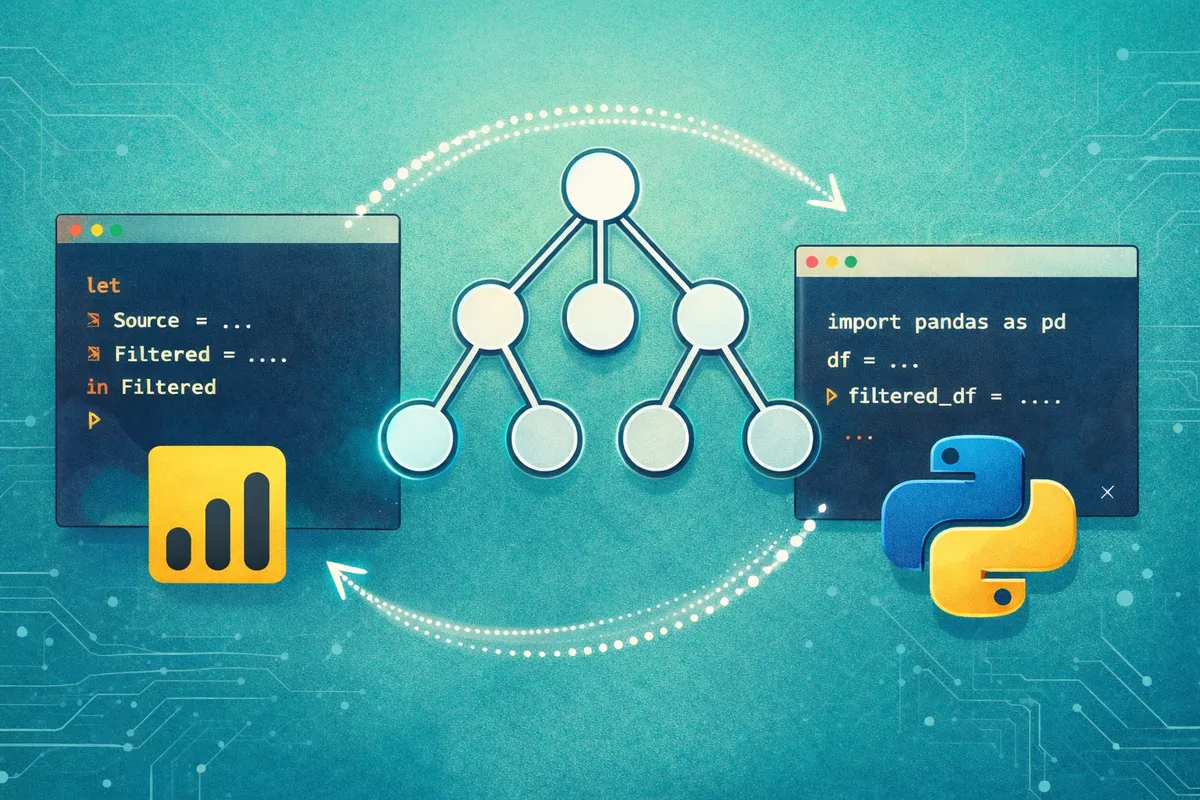

A Power Query to Python converter that automatically translates PowerQuery M language scripts into executable Python code. Built with Go, this interpreter parses PowerQuery syntax and generates equivalent Python code, supporting a wide range of PowerQuery functions.
Overview
PQC-PowerQueryConverter is designed to bridge the gap between Microsoft’s Power Query M language and Python, enabling users to convert their data transformation scripts seamlessly. The project implements a complete interpreter pipeline including lexical analysis, parsing, and code generation.
Features
- Full Interpreter Pipeline: Lexer → Parser → Interpreter → Python Code Generation
- Extensive Function Support: Text, Table, Binary, and TypeValue functions
- Symbol Table Management: Tracks variables and manages code generation
- Detailed Logging: Built-in logger for debugging and monitoring conversion process
- Test Coverage: Comprehensive test suites for both Go and Python output validation
Project Structure
/interpreter
The heart of the conversion process, containing the complete interpretation pipeline:
/lexer- Tokenizes PowerQuery M code into a stream of tokens for parsing/parser- Builds an Abstract Syntax Tree (AST) from tokens; includes specialized function parsing/nodes- Defines all AST node types (functions, operators, strings, numbers, tables, etc.)/token- Token type definitions and token identification logic/symboltable- Manages variables, generates Python code, and tracks dependenciesinterpreter. go- Main interpreter that orchestrates the conversion process
/powerquery
PowerQuery-specific implementations and type definitions:
/functions- Implementation of PowerQuery functions organized by category:/binary- Binary data manipulation functions/table- Table operations and transformations/text- String manipulation functions/typevalue- Type conversion and value creation functions
/types- PowerQuery data type definitions and common types/enumerations- PowerQuery enumerations (compression types, encodings, comparers, etc.)/functiontypes- Function type classifications and metadata
/handler
Utility handlers for common operations:
filehandler.go- File I/O operations for reading PowerQuery scriptsstackhandler.go- Stack data structure for expression evaluationvaluehandler.go- Value manipulation and type handling utilities
/logger
Custom logging implementation with debug, info, and error levels for tracking the conversion process.
/tests
Go test suite for validating the interpreter:
/examples- Sample PowerQuery scripts for testingexamples_test.go- Automated tests for example conversionsrun_function. go- Test runner utilities
/python-tests
Python validation scripts to verify the generated Python code executes correctly:
- Sample Python files demonstrating converted PowerQuery operations
- Test cases for binary, table, text, and typevalue operations
- Python environment configuration (
.python-version,pyproject.toml)
Configuration Files
go.mod- Go module dependenciesmain.go- CLI entry point that orchestrates the conversionLICENSE- Project licenseSUPPORTED_FUNCTIONS.md- Comprehensive list of supported PowerQuery functions with implementation status
How It Works
The conversion process follows these steps:
- Lexical Analysis: The lexer reads the input PowerQuery file and converts it into tokens
- Parsing: The parser constructs an Abstract Syntax Tree (AST) from the token stream
- Interpretation: The interpreter walks the AST, resolving functions and building the symbol table
- Code Generation: Python code is generated with proper dependencies and variable assignments
- Output: The final Python script is produced, ready for execution
Usage
go run main.go <path-to-powerquery-file>The converter will:
- Read your PowerQuery script
- Parse and interpret the code
- Generate equivalent Python code
- Output the result with detailed logging
Supported Functions
The project supports a wide range of PowerQuery functions across multiple categories:
Fully Supported
- TypeValue Functions:
#date,#datetime,#datetimezone,#table - Binary Functions: 13+ functions including
Binary. Combine,Binary.ToText,Binary.FromList - Text Functions: 40+ functions including
Text.Split,Text.Replace,Text.Combine - Table Functions: Column operations, transformations, and data manipulation
In Progress
- Additional table transformation functions
- Advanced table operations (joins, grouping, aggregation)
See SUPPORTED_FUNCTIONS.md for the complete list with detailed descriptions.
Testing
cd tests
go test -v
Built with Go | Generates Python | Powered by AST